
Red Sandalwood Farming Guide 2025 | High Profit Crop for Farmers | Full Details
Red sandalwood Tree Cultivating has acquired colossal ubiquity as a result of the great scent of sandalwood or Chandan and its wood materials have been utilized for quite a long time. sandalwood trees are significantly known as sandalwood or Srigandha and it is the most costly tree plant. sandalwood is an evergreen tree that is generally utilized in business, remedial, restorative, and meds. the greatest level of sandalwood ranges between 13 to 16 meters and its size would be around 100 to 200 cm. These Sandalwood Trees are tracked down in India, Bangladesh, Sri Lanka, Australia, Pakistan, Hawaii, Indonesia, and Pacific Islands.
This guide covers complete Red Sandalwood Farming details—from soil, climate, plantation, spacing, care, cost, ROI, pests, harvesting, and selling.
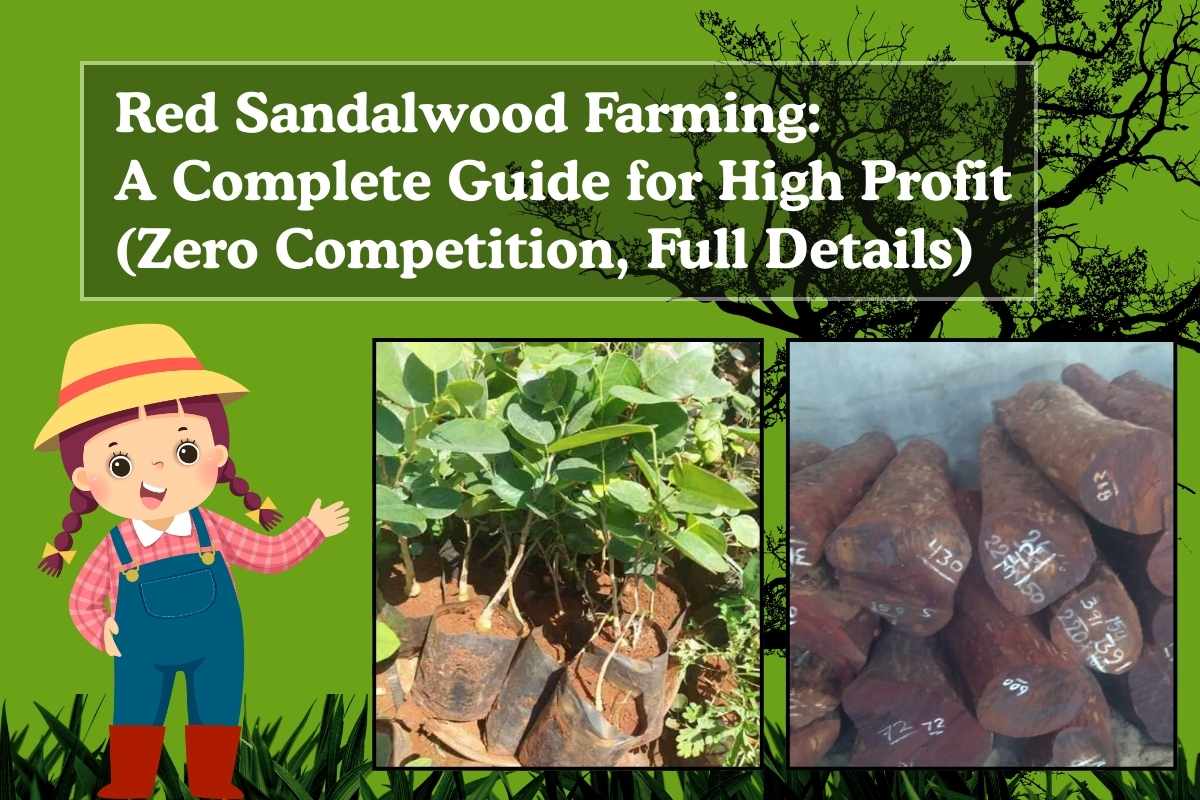
Table of Contents
What is Red Sandalwood?
Red Sandalwood (Pterocarpus santalinus) is a valuable hardwood species mainly grown in South India. Its heartwood is used in medicines, cosmetics, handicrafts, idols, and dyes.
Climate Required
- Ideal temperature: 12°C–38°C
- Needs moderate rainfall
- Grows best in dry tropical climate
- Can tolerate drought
This makes it suitable for most Indian states.
Best Soil for Red Sandalwood Farming
- Red soil, black soil, light sandy soil
- Soil pH: 6.5 – 8.0
- Well-drained soil is best
Avoid waterlogging at any cost.
Plant Spacing & Plantation
- Distance: 10 ft × 10 ft
- 1 Acre accommodates: 400 plants
- Plant in monsoon (June–August)
- Provide deep pits (2 ft × 2 ft × 2 ft)
Water Management
- Young plants need watering every 7–10 days
- Mature trees rarely need irrigation
- Avoid excessive watering
Fertilizer Schedule
Year 1–3:
- 5–10 kg FYM per plant
- NPK 100:50:50 once per year
After 3 years:
- Minimal fertilizer required
Pest & Disease Management
Red Sandalwood is naturally resistant, but termites, stem borers
can attack young plants.
Use:
- Neem cake
- Chlorpyrifos (only if needed)
Honorable Deputy Chief Minister and Minister for Forests and Environment Shri @PawanKalyan inspecting the Red Sandalwood Depot in Tirupati district.#AndhraPradesh pic.twitter.com/fKXVB98MDa
— JanaSena Shatagni (@JSPShatagniTeam) November 8, 2025
Cost of Red Sandalwood Farming (Per Acre)
Particular Cost
- Plants (400) ₹40,000–₹60,000
- Pit preparation ₹20,000
- Fertilizer + labour ₹15,000/year
- Total 1st year cost ₹70,000–₹1,00,000
Income & Profit from Red Sandalwood Farming
A fully mature tree (12–15 years) yields:
15–20 kg heartwood per tree
Current average price:
₹8,000 – ₹20,000 per kg (depending on quality)
Profit per tree:
₹1,20,000 to ₹3,00,000
Profit per acre (400 trees):
₹4.5 crore – ₹12 crore (in 12–15 years)
One of the most profitable long-term crops in India.
Harvesting Time
- Best harvesting: 12–15 years
- Wood becomes darker & harder
- Higher age = higher price
Where to Sell Red Sandalwood?
- Government auctions
- Authorized timber traders
- Exporters
- Ayurvedic companies
- Handicraft industries
Advantages of Red Sandalwood Farming
- High Profit
- Long-term security
- Very low maintenance
- Disease-resistant
- Huge export demand
- Climate adaptable
Disadvantages of Red Sandalwood Farming
- Long waiting period
- High initial cost
- Govt permissions required for cutting
- Market fluctuations
Conclusion
Red Sandalwood Farming is a high-income, long-term asset for farmers who want life-changing profits with minimum maintenance. Although it takes more time to mature, the final income is massive, making it a top choice crop for visionary farmers.
FAQs
1. What is the best climate for Red Sandalwood farming?
Red Sandalwood grows best in dry tropical climate with temperatures between 12°C to 38°C, and moderate rainfall.
2. How many Red Sandalwood plants can be grown in one acre?
With 10×10 ft spacing, around 400 plants can be planted in 1 acre.
3. How long does Red Sandalwood take to mature?
Red Sandalwood becomes fully mature in 12–15 years.
More maturity = higher heartwood weight + higher selling price.
4. What is the profit from Red Sandalwood per acre?
Profit per acre ranges from ₹4.5 crore to ₹12 crore depending on quality, tree age, and heartwood weight.
5. What is the price of Red Sandalwood wood per kg?
Market price: ₹8,000 – ₹20,000 per kg (quality & demand based).
6. Is permission required to cut Red Sandalwood trees?
Yes. Cutting, harvesting, and transporting Red Sandalwood require government permissions and documentation.
7. Does Red Sandalwood need high maintenance?
No. It is a low-maintenance, drought-tolerant tree that grows well with minimal care after 3 years.
8. Which soil is best for Red Sandalwood farming?
- Red soil
- Sandy soil
- Black soil
- A well-drained soil with pH 6.5 to 8 is ideal.
9. How much water does Red Sandalwood need?
Young plants need water every 7–10 days.
Mature trees need very little water and tolerate drought well.
10. What is the best month to plant Red Sandalwood?
June to August (Monsoon season) is the best time for plantation.
11. Where can I sell Red Sandalwood wood?
- Government auctions
- Authorized timber traders
- Ayurvedic companies
- Exporters
- Handicraft industries
12. Which pests attack Red Sandalwood trees?
Mostly resistant, but young plants may face
- Termites
- Stem borers
(Neem cake helps in protection)
13. What is the average heartwood yield per tree?
A mature tree yields 15–20 kg of high-quality heartwood.
14. Is Red Sandalwood better than White Sandalwood for farming?
For commercial value and export demand, Red Sandalwood is more profitable.
But White Sandalwood matures earlier and gives fragrance-based products.
15. Can Red Sandalwood be grown in North India?
Yes. It grows well in many states except extremely cold regions.
16. Does Red Sandalwood survive heavy rainfall?
It prefers moderate rainfall.
Excess water or flooding damages roots.
17. What is the lifespan of a Red Sandalwood tree?
Red Sandalwood trees live 50–100+ years.
18. How deep should the planting pit be?
Dig pits of 2×2×2 feet and fill with soil + FYM.
19. What is the biggest advantage of Red Sandalwood farming?
Very high long-term profit with low maintenance.
20. What is the biggest disadvantage of Red Sandalwood farming?
The long waiting period (12–15 years) before harvesting.