Precision and Smart Farming in India: Ultimate 2025 Guide to NDVI, Soil Sensors, and Water‑Saving Irrigation.
Precision Farming in India is a data‑driven way to apply the right water, nutrients, and crop care at the right place and time, boosting yield while cutting input costs. It combines free satellite NDVI/EVI maps, simple soil moisture sensors, and weekly irrigation schedules so even small farms can act early on stress and save resources.
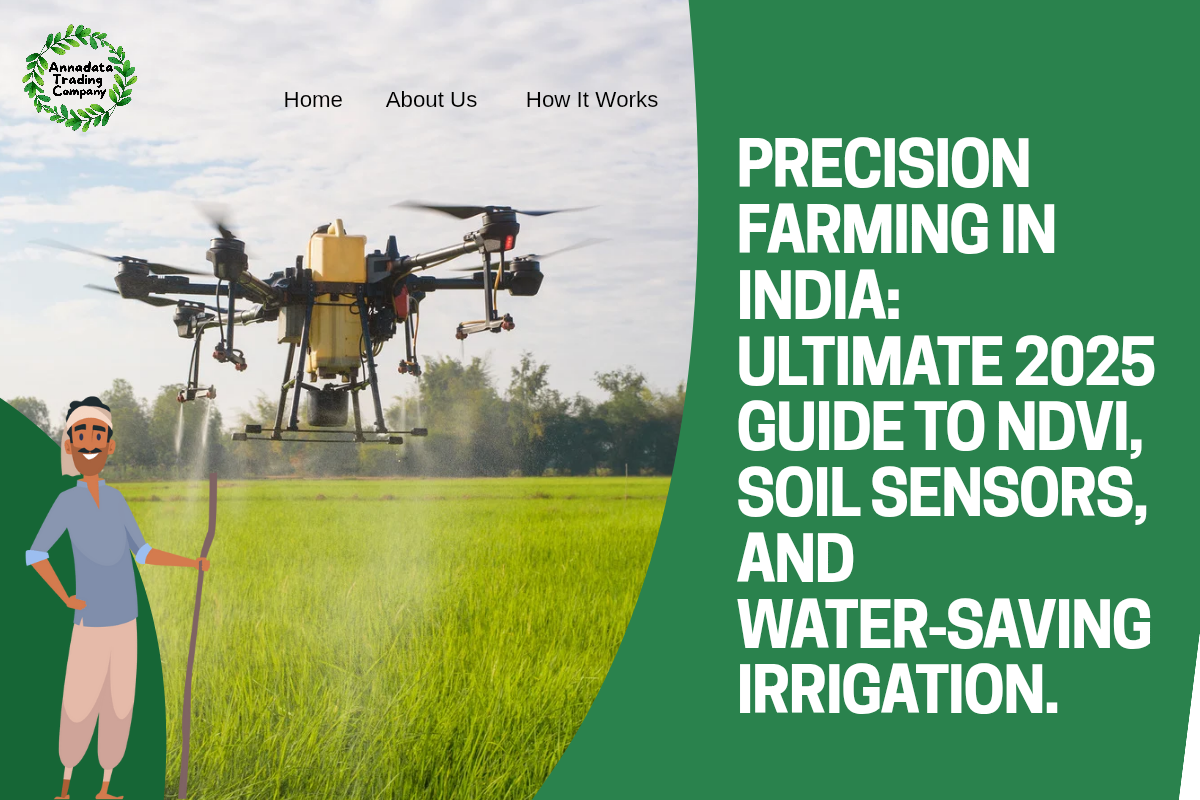
Table of Contents
What NDVI Is and Why It Matters
- NDVI highlights plant vigor so farmers can spot stress 7–10 days before it’s visible, enabling timely action on water and nutrients.
- Combine NDVI with weather and soil moisture layers to create simple management zones for variable input application.
Precision Farming in India: Free Ways to Access NDVI and Field Maps
- Use platforms that provide NDVI/EVI and historical time‑series, with options to view soil moisture and evapotranspiration layers.
- Set up change alerts to flag sudden NDVI drops and ground‑truth only those patches to save scouting time.
Soil Moisture Sensors: The Budget Workhorse
- Place sensors at two depths (e.g., 15 cm and 45–60 cm) in representative zones; install early and ensure firm soil contact.
- Calibrate low‑cost sensors to local soil for reliable thresholds; use field capacity and management allowable depletion (MAD) to trigger irrigation.
Precision Farming in India: Simple Irrigation Scheduling SOP
- Track daily reference ET and rainfall, update a water balance sheet, and irrigate before 50% depletion for the crop and soil type.
- Cross‑check with sensor readings and NDVI change maps to prioritize stressed zones first.
कृषि 5.0 की ओर छलांग
— Agriculture Department, MP (@minmpkrishi) November 11, 2025
---
राजधानी भोपाल में ड्रोन और रोबोटिक्स से खेती में नई क्रांति
➡️ ‘स्मार्ट यंत्र’ बनेंगे छोटे किसानों का संबल
➡️ तकनीक से बढ़ेगी उपज, घटेगी लागत@DrMohanYadav51 #Krishi5_0 #SmartFarming #MadhyaPradesh #FarmTech #DigitalIndia pic.twitter.com/FJkxBx4mut
Precision Farming in India: Soil EC And Nutrient Management
- Use handheld EC and pH tools to detect salinity or nutrient issues and to guide fertigation strength.
- Pair NDVI with EC/pH spot checks in low‑vigor patches to decide if the issue is water, nutrition, or pest/disease.
Putting It Together: Weekly Workflow
- Monday: Review NDVI time‑series and alerts, mark low‑index patches for visit.
- Midweek: Read sensors, log ET/rain, update water balance, and schedule irrigation by zone.
- Friday: Spot‑sample EC/pH in problem areas; adjust fertigation or irrigation; note outcomes for next week.
Precision Farming in India: Starter Kit (Low Budget)
- 2 soil moisture sensors + basic reader, handheld EC/pH meters, and access to a free NDVI platform; optional GPS pins via mobile.
- Add a simple spreadsheet or app to log ET, rainfall, sensor values, and actions; this builds your seasonal playbook.
Precision Farming in India: Case‑Style Outcomes To Aim For
- Early stress detection prevents spread and protects yield; targeted sprays or irrigation only where needed lowers cost and footprint.
- Aligning harvest timing using NDVI maturity patterns reduces passes and fuel while improving grain or fruit uniformity.
Conclusion
Precision and smart farming in India is moving from “nice to have” to essential, because it boosts yields, cuts input waste, and strengthens climate resilience with targeted, data‑driven decisions across water, nutrients, and crop protection. by pairing free satellite NDVI/EVI maps with affordable soil‑moisture sensors and simple irrigation schedules, even smallholders can act early on stress, reduce chemical overuse, and improve profitability without expensive drones or complex systems. with growing government and ecosystem support in 2025, adopting these workflows now positions farms for sustained gains in productivity, sustainability, and market competitiveness over the coming seasons.
FAQs
1) Do I need a drone?
A- No; free satellite NDVI and basic sensors cover most use‑cases for small farms.
2) How often should I check NDVI?
A-Weekly during peak growth; increase frequency when weather stress is forecast.
3) What if clouds block imagery?
A- Use platforms that provide cloud‑free composites or check index alternatives like EVI.
4) What is Precision Farming in India?
A- Precision farming is a data‑driven approach that uses tools like satellite NDVI/EVI maps, soil moisture sensors, and GPS/GIS to apply water and nutrients only where needed, improving yield and cutting waste.
5) Do I need a drone to start precision farming?
A- No. Free satellite NDVI platforms plus low‑cost soil moisture sensors are enough for small farms to detect stress early and schedule irrigation accurately.
6) How often should I check NDVI maps?
A- Weekly during active growth, and more frequently around heat waves or disease alerts; use change alerts to flag sudden drops and prioritize scouting.