
Ashwagandha Farming Guide 2025: Soil, Spacing, Yield, Profit in India.
Ashwagandha (Withania somnifera) is a hardy Ayurvedic medicinal crop grown primarily for its roots, valued in nutraceuticals, adaptogens, and herbal formulations; it thrives in warm, semi‑arid zones and matures in about 5–6 months, making it an attractive option for low to medium rainfall regions in India. major cultivation belts include Rajasthan, Madhya Pradesh, Haryana, and Gujarat due to suitable climate and soils.
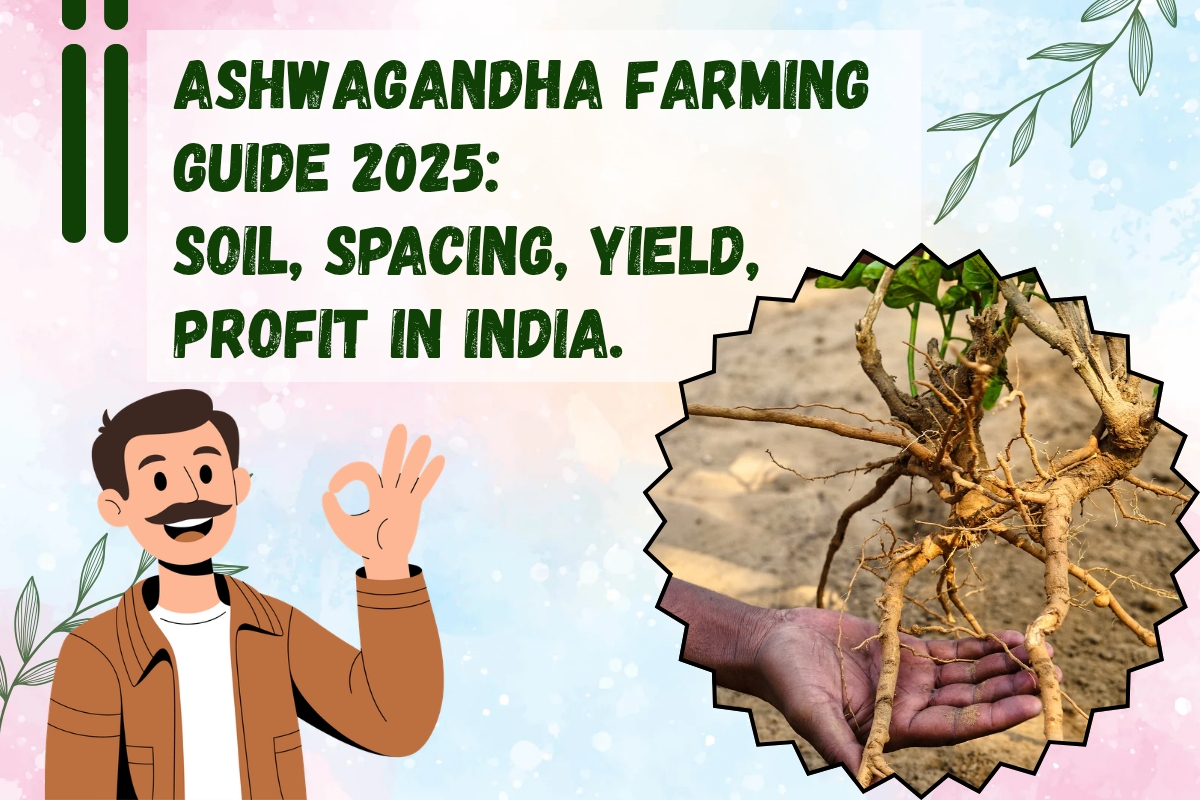
Table of Contents
Ashwagandha Farming: Climate and soil.
- Climate: Sub‑tropical to semi‑arid; prefers a relatively dry growing period with occasional winter showers; ideal where annual rainfall is ~500–750 mm.
- Temperature: Warm conditions are preferred; crop is generally raised as a Kharif planting and matures in winter.
- Soil: Sandy loam to light red, well‑drained; pH 6.5–8.0; avoid waterlogging; black/heavier soils can be used if drainage is ensured.
Ashwagandha Farming: Land Preparation.
- Plough 2–3 times and harrow to fine tilth; incorporate 10–20 t/ha of well‑decomposed FYM during the last ploughing to improve structure and moisture retention.
- Ensure field drainage; raised beds or ridges help in heavier soils to protect roots from rotting and ease harvest.
Ashwagandha Farming: Varieties and planting season.
- Common improved lines include Vallabh Ashwagandha and regionally recommended selections under ICAR‑AICRP on MAPs; choose locally adapted material for stable alkaloid content and root size.
- Season: Nursery sowing or direct seeding around onset of monsoon (June–July); crop duration 150–180 days, harvesting in Jan–Mar when leaves dry and berries turn yellow‑red.
Ashwagandha Farming: Propagation methods.
- Direct seeding: Preferred in many regions; seeds sown 1–3 cm deep in lines for uniform stand and easier interculture.
- Nursery and transplanting: Raise seedlings in June–July; transplant at 25–35 days when sturdy; useful where precision spacing or gap‑filling is needed.
Click on the button below for plants or seeds.
Ashwagandha Farming: Seed rate and Spacing.
- Lorem ipsum dolor sit amet, consectetur adipiscing elit. Ut elit tellus, luctus nec ullamcorper mattis, pulvinar dapibus leo.Seed rate: 10–12 kg/ha for broadcasting; lower for line sowing due to better placement; nurseries may need ~0.5–0.75 kg to raise transplants for 1 ha.
- Spacing: Line to line 20–25 cm and plant to plant 8–10 cm is widely recommended for higher root yield; some systems use ridges 60 cm apart with 30 cm plants for transplanted crops.
Ashwagandha Farming: Sowing and germination.
- Treat seed with a fungicide such as carbendazim or thiram to reduce seed‑borne diseases, then sow before or just after first monsoon showers; germination typically occurs in 5–7 days under warm, moist conditions.
- Cover lightly with soil or sand; maintain a fine tilth and surface moisture for even emergence during the first week.
Ashwagandha Farming: Nutrient Management.
- Lorem ipsum dolor sit amet, consectetur adipiscing elit. Ut elit tellus, luctus nec ullamcorper mattis, pulvinar dapibus leo.Ashwagandha is a low to moderate nutrient‑demand crop; FYM at 10–20 t/ha supports early vigor and root development under rainfed conditions.
- Where used, light basal N and P (e.g., 20:20 kg/ha) can be applied judiciously; excessive nitrogen promotes foliage at the cost of root quality and alkaloid concentration.
Ashwagandha Farming: Irrigation schedule.
- Mostly grown rainfed; avoid frequent irrigation as excess moisture increases fiber in roots and reduces quality; irrigate only to maintain moisture at 15–20 day intervals in prolonged dry spells.
- Winter rains are beneficial for root bulking; ensure rapid drainage after any heavy rainfall events to prevent rots.
Interculture and weed control.
- Lorem ipsum dolor sit amet, consectetur adipiscing elit. Ut elit tellus, luctus nec ullamcorper mattis, pulvinar dapibus leo.One timely hand weeding early in the crop can be sufficient; the crop’s canopy gradually suppresses later weeds due to a smothering effect.
- Line sowing enables easy hoeing and aeration, which supports root enlargement and reduces competition for moisture and nutrients.
Ashwagandha is no longer just an Ayurvedic herb, it is today’s green gold. Farmers in Madhya Pradesh and Rajasthan are already earning lakhs from this drought-resistant crop.#FAIFA #farming #agriculture pic.twitter.com/hOfG0NbSww
— The Federation of All India Farmer Associations (@FAIFA_Official) October 3, 2025
Ashwagandha Farming: Pests and diseases.
- Seedling damping‑off and blight can occur under hot, humid conditions; manage with disease‑free seed, seed treatment, proper drainage, and timely sowing.
- Soil pests and nematodes can damage roots; apply neem cake and consider carbofuran at sowing where permitted and as per label directions to protect young plants.
Harvesting and post‑harvest.
- Harvest at 150–180 days when leaves have dried and berries turn yellow‑red; dig or lift plants carefully to retain full root length and diameter.
- Wash roots, cut to 7–10 cm pieces, and sun‑dry to a safe moisture level; separate berries, dry, and crush to extract seeds; grade roots for 6–15 mm diameter and desired length.
Ashwagandha Farming: Yield and quality.
- Typical dry root yield is about 3–5 quintals per hectare, with 50–75 kg seed; best‑managed fields may reach 6.5–7.0 q/ha of roots under favorable conditions.
- Root alkaloid content commonly ranges around 0.13–0.31%; good agronomy and proper maturity help achieve consistent quality for herbal markets.
Ashwagandha Farming: Economics and Profitability.
- Ashwagandha is considered financially viable with favorable benefit‑cost ratios in field studies; profitability depends on yield, quality, and market linkages in Ayurvedic supply chains.
- Regional analyses indicate positive net returns where cultivation practices and post‑harvest handling are optimized; explore state schemes like National AYUSH Mission for support.
Ashwagandha Farming: State focus and support.
- Leading producing states include Rajasthan, Madhya Pradesh, Haryana, and Gujarat due to climate suitability and established procurement networks for medicinal herbs.
- Check state horticulture/AYUSH portals for current subsidies, planting material sources, and buy‑back programs to reduce market risk.
Practical tips for higher returns.
- Prefer line sowing and keep spacing consistent to enhance root uniformity and ease weeding and harvesting.
- Avoid over‑irrigation; controlled moisture improves root texture and reduces fibrousness, supporting better grading outcomes.
Conclusion.
Ashwagandha offers a short 150–180 day cycle, low irrigation needs, and reliable returns in semi‑arid Indian climates, making it an excellent diversification crop for marginal and rain‑fed lands when grown on well‑drained sandy loam with proper spacing and minimal inputs. field evidence shows strong economics with favorable benefit–cost ratios when best practices are followed—line sowing, restrained irrigation, timely weeding, and careful harvest/drying to preserve root quality and alkaloids—supported by growing Ayurvedic and export demand. by choosing locally adapted varieties, optimizing post‑harvest handling, and leveraging state schemes and buyer linkages, farmers can consistently achieve marketable root grades and improved net income from this resilient medicinal crop.
FAQs.
1) Is Ashwagandha farming profitable in India?
A- Yes, demand from Ayurvedic and nutraceutical sectors plus a 150–180 day crop cycle and low water needs make it profitable when good agronomy and post‑harvest handling are followed.
2) Which states are best for Ashwagandha cultivation?
A- Rajasthan, Madhya Pradesh, Haryana, Gujarat, and parts of Punjab and Maharashtra lead due to semi‑arid climate and procurement networks.
3) What climate and soil are ideal?
A- Warm, semi‑arid regions with about 500–750 mm rainfall and well‑drained sandy loam or light red soils, pH roughly 6.5–8.0, are ideal.
4) What is the crop duration?
A- About 150–180 days from sowing to harvest; Kharif sowing with winter harvesting is common.
5) What is the recommended seed rate?
A- For broadcasting, about 10–12 kg/ha; nurseries need far less seed for transplanting; per‑acre guides often suggest 4–5 kg for direct sowing.
6) What spacing should be used?
A- Line spacing of 20–25 cm between rows and 8–10 cm between plants for direct seeding is widely recommended; transplanted crops may use 60 cm x 30 cm on ridges.
7) When and how should seeds be sown?
A- Sow around onset of monsoon at 1–3 cm depth; treat seed with a fungicide or biocontrol to prevent damping‑off; germination occurs in 5–7 days.
8) How much irrigation is required?
A- Mostly rainfed; irrigate sparingly during prolonged dry spells and ensure drainage; avoid over‑irrigation to maintain root quality.
9) What fertilizers or manures are recommended?
A- Incorporate 10–20 t/ha of well‑decomposed FYM; excess nitrogen reduces root quality; organic systems prefer FYM, vermicompost, and green manures.
10) What are common pests and diseases?
A- Seedling damping‑off, blight, and nematodes can occur; use treated or disease‑free seeds, good drainage, and crop hygiene practices.
11) When is the crop ready for harvest?
A- Harvest when leaves dry and berries turn yellow‑red, typically Jan–Mar; duration is 150–180 days post‑sowing.
12) How are roots processed after harvest?
A- Lift carefully, wash, cut roots into 7–10 cm pieces, and sun‑dry to safe moisture; dry and crush berries to extract seeds.
13) What yield can farmers expect?
A- Dry root yields commonly range 3–5 q/ha under typical management; seed yield is modest and varies with practices and region.
14) Are there government schemes for support?
A- Refer to National AYUSH Mission and state horticulture/Ayush departments for nursery material, training, and possible subsidies or buy‑back linkages.
15) Which improved varieties are available?
A- Regionally recommended selections and ICAR‑linked materials are used; check local agri/AYUSH sources for currently recommended varieties and seed supply.