
Best Crops to Grow for High Profit in 2025 (Low Investment Farming Ideas)
Farming in 2025 will bring immense opportunities for farmers who choose the right crops. With the growing demand for vegetables, wildflowers, and fast-growing fruit crops, both small and large farmers can earn substantial profits with minimal investment. This allows every farmer to earn substantial profits through zero-maintenance, low investment farming.
Here are the top 10 most profitable crops to grow in 2025.
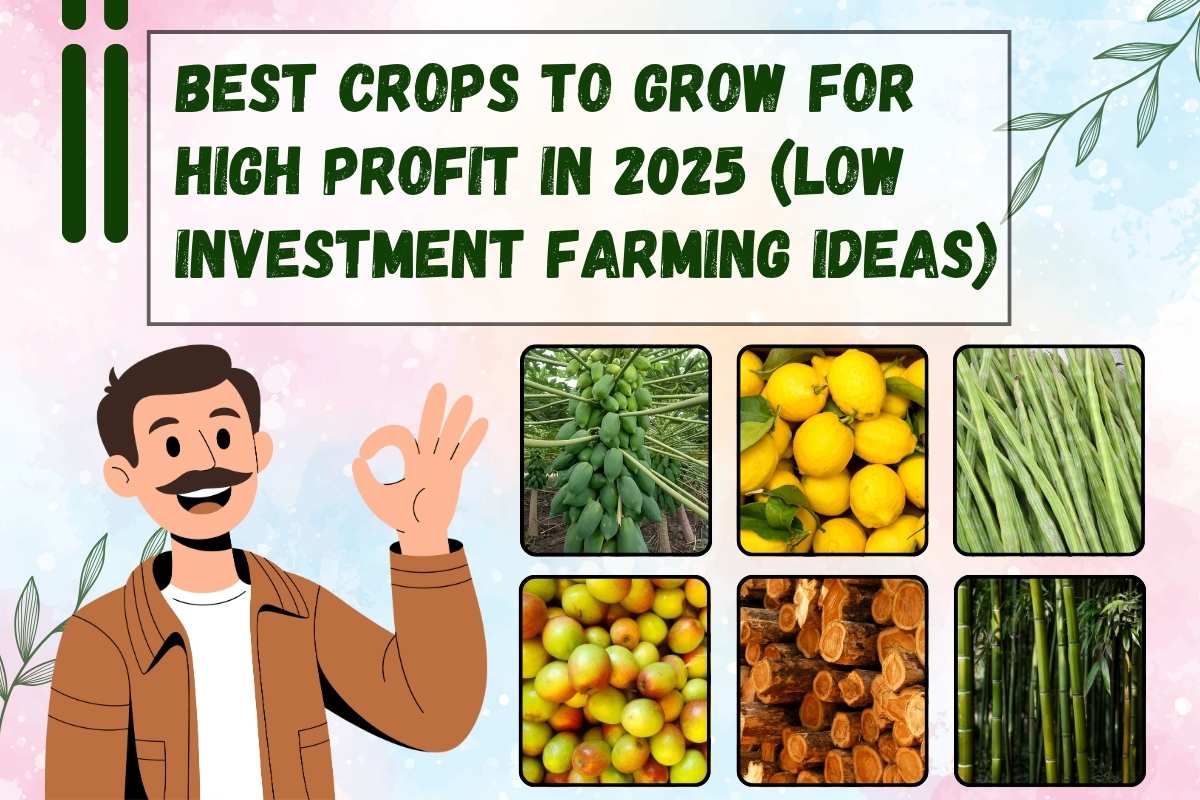
Table of Contents
1) Drumstick Farming (Sahjan/Moringa)
If you want to earn high profits in a short time, drumstick farming is one of the most profitable crops, allowing you to earn substantial profits in a short time. Drumstick is the only plant whose leaves, roots, and wood provide a profitable return. Regarding the market for drumstick, you can easily sell drumstick pods at a good price in the local market, and not to mention the foreign market, which also sells them at very high prices. For this reason, drumstick farming is one of the most profitable low investment farming options.
2) Papaya Farming (15 Number Papaya Variety)
If you’re thinking about low investment farming and profitable farming in a short time, papaya farming is the only farming option that can earn you a substantial profit in a short time. There are many varieties of papaya from which you can earn substantial profits, but variety number 15 is considered one of the best varieties because it’s virus-free and begins to bear fruit in a very short time. The fruit size of this variety is also quite good, due to which you can earn a substantial profit in the market. Talking about the papaya market, there is a high demand for papaya not only in India but also abroad, due to which you can easily earn a substantial profit by selling papaya fruits.
3) Lemon Farming (Kagzi All Time Variety)
When we think about low maintenance and low investment farming, the first thought that comes to mind is lemon farming, as it’s a low-cost farming. It’s a lemon cultivar that yields good profits at a low cost. If you’re considering lemon farming, the Kagzi variety is one of the most popular because its fruit has a very thin peel, creating a strong demand for it in the market. It’s also known as “Kagzi Lemon.” Furthermore, this variety produces perennial fruit, allowing you to earn a good profit by selling lemons in the market every season.
4) Custred Apple Farming (Sitafal/Sherifa/Annona squamosa)
Custard apple is a sweet and granular fruit popular in India. It’s also known as custard apple. It’s easy to cultivate and grows well even with limited water. Custard apple is a tropical fruit plant, whose pulpy sweetness and granular texture make it unique. It thrives even in extreme heat and drought. Custard apple plants begin bearing fruit within three years. A single custard apple tree yields 20-40 kilograms of fruit. This means you can easily produce 3 tons of produce from one acre, with a market value of ₹80-₹150 per kilogram (depending on the region). This means you can easily earn ₹100,000-₹300,000 from one acre. Custard apple cultivation is a very low-maintenance crop, making it a low investment farming option.
5) Apple Ber Farming (Banarasi/Kashmiri /Thai Apple Ber)
Apple Ber is an improved, high-quality hybrid variety of plum. Its fruits are larger, crisper, sweeter, and shinier than regular plums. It is also known by its cultivar name: Banarasi/Kashmiri/Thai Apple Ber. Warm, dry climates are best for apple plum plants. Ber plants reach full fruiting stage in two years, yielding 25-40 kilograms of fruit per plant. If you assume an average yield of 8-12 tons per acre (depending on care) and a market price of ₹30-₹80 per kilogram, you can earn ₹200,000-₹600,000 annually from one acre. Apple Ber cultivation is a zero-maintenance process that requires very few pesticides, making it a low investment farming method.
6) Bamboo Farming (Manvel/Solid Bamboo/Dendrocalumas Strictus)
Bamboo cultivation is considered a low investment farming because you can grow bamboo plants from seeds right on the farm. Furthermore, bamboo cultivation costs significantly less than other plants, allowing you to earn substantial profits with minimal investment. There are many varieties of bamboo, but the most widely grown variety in India and one that thrives in all climates is Dendrocalumbus strictus, also known as Manvel or solid bamboo. This variety is very strong and solid, allowing you to easily sell it in the market and earn a good profit.
In 2017, Nitin Gadkari was sad that India is highly dependent on Taiwan and China for our Bamboo needs
— FinFloww (@FinFloww) August 16, 2023
Despite being the 2nd largest producer of Bamboo in the world
So, he is hell bent on destroying China’s monopoly in Bamboo
Here’s how India is becoming a Bamboo superpower:… pic.twitter.com/CZB35fAmkU
7) Teak Wood Farming
Teak is India’s most sought-after precious timber tree. Its wood is considered to be the strongest and most durable in the world. Teak is a hardwood tree, also known as teak, found primarily in tropical regions. In India, it is cultivated extensively in Madhya Pradesh, Maharashtra, Chhattisgarh, Odisha, and South India. Teak wood is termite and water resistant. It is used in furniture, doors, windows, boats, and luxurious interiors. Teak saplings are ready for sale in 15 years, allowing you to earn substantial profits. If you are considering low investment farming, teak farming is the most profitable option.
Click on the button below for plants or seeds.
8) Sandalwood Farming (Red and Sandalwood)
If I told you that you could earn crores in profits from farming, you’d laugh at me and say, “Don’t tell me anything. Can anyone really earn crores from farming?” But it’s 100% true. Yes, you heard it right. It’s 100% true. You’d say, “How?” The answer lies in the sandalwood plant. Yes, you heard it right. Sandalwood plants can make you a millionaire. Sandalwood is the only plant that can generate crores in profits. There are two main varieties of sandalwood, white sandalwood and red sandalwood, which are in high demand in the market. Sandalwood plants become marketable in 15 years. You can easily grow these plants from seeds in your field, making it a low investment farming method. By planting them, you can earn substantial profits at a low cost.
9) Malabar Neem Farming (Melia Dubia)
If you’re wondering if it’s possible to grow a plant that requires very little fertilizer and water, can be planted in all types of soil, and can yield substantial profits in a short time, then you’re right. There’s a plant that can yield substantial profits in a short time without much fertilizer or water. That plant is the Malabar Neem tree. Malabar Neem trees are capable of producing wood in seven years, and Malabar Neem cultivation requires very little fertilizer and water, making it easily accessible to anyone. Malabar Neem cultivation is a low-maintenance, low investment farming, with minimal fertilizer and labor costs. Simply plant the saplings in the field and leave them. After seven years, the wood will be ready for sale in the market, allowing you to earn a substantial profit.
10) Mahogany Farming (African Mahogany)
If we talk about low investment farming, mahogany farming would rank among the top 5 because it costs very little to grow plants from seeds, and any farmer can easily grow them in their fields. Mahogany wood is one of the strongest woods. It does not rot even after being submerged in water for 100 years. You may find it strange to hear that such wood actually exists. You will be surprised to hear that yes, there is a wood that does not rot even after being submerged in water for 100 years. This is why boatbuilding companies use the wood of this tree, making the ships made from it rot-resistant and long-lasting. This is a wood that is listed as one of the most expensive woods in India and the world.
How to Choose the Right High-Profit Crop for Your Farm?
1. Your Climate Zone
Different crops grow best in different temperature condition.
- Warm climates: Papaya, Drumstick, Lemon, Custard Apple, Apple Ber, Bamboo, Malabar Neem
- Moderate to Warm Climate: Mahogany, Teak
- Moderate climates: Sandalwood
Choose crops that naturally grow well in your temperature range.
2. Soil Type
Your soil must match the crop requirements for best yield.
- Red / Well-drained Soil: Sandalwood, Mahogany, Teak, Malabar Neem
- Loamy soil: Papaya, Drumstick, Lemon, Custard Apple, Apple Ber
- Sandy-Loam Soil: Bamboo
Do a basic soil test to know pH and nutrient levels.
3. Water Availability
Water availability affects the choice of crop.
- Low-Water Requirement Crops: Drumstick, Lemon, Apple Ber, Sandalwood, Mahogany, Teak, Malabar Neem, Bamboo
- Medium-Water Crops: Papaya, Custard Apple
Choose drought-resistant crops if you depend on rainfall.
4. Market Demand in Your Area
A crop becomes profitable only when it sells easily.
- High Daily/Regular Demand: Papaya, Lemon, Drumstick
- Seasonal but Premium Demand: Custard Apple, Apple Ber
- Long-term High-Value Demand: Sandalwood, Mahogany, Teak, Malabar Neem, Bamboo
Grow crops with strong, regular market demand.
5. Budget & Land Size
Your investment and land area decide how big or long-term your crop can be.
- Small land / low investment: Lemon, Drumstick, Vegetables
- Medium land: Papaya
- Large land: Bamboo, Malabar Neem, Sandalwood
- Small Land / Low Investment: Drumstick, Lemon, Apple Ber, Papaya
- Medium Land: Custard Apple, Papaya, Bamboo
- Large Land (Long-term profit crops): Sandalwood, Mahogany, Teak, Malabar Neem, Bamboo
Small farmers should choose fast-income crops.
Large farmers can choose long-term commercial crops.
Most Profitable Crops for Small Farmers (Low Investment)
Papaya
- Starts fruiting in 7–8 months
- High demand in fresh market
- Very good profit with low maintenance
- Suitable for warm climates and loamy soil
Drumstick (Moringa)
- Very low water requirement
- Pods, leaves, and powder all have strong market demand
- Grows fast and gives income within months
- Best for low-investment farmingLemo
Lemon
- All-season demand
- Continuous fruiting for years
- Very low maintenance and high profit
- Ideal for small farmers and warm climate.
Custred Apple
- Premium seasonal fruit with high market price
- Grows well in low water conditions
- Strong demand in local and export markets
- Low maintenance fruit crop
Apple Ber
- Hardy crop, survives in dry conditions
- High fruiting with minimal care
- Sweet fruits have strong local market demand
- Fast-growing and highly profitable
Most Profitable Long-Term Crops
Bamboo
- Fast-growing commercial crop
- High demand in construction, paper, and furniture
- Very low maintenance after planting
- Provides regular income for many years
Malabar Neem (Melia Dubia)
- One of the fastest-growing timber trees
- Harvest ready in 5–7 years
- High demand in plywood and wood industries
- Low water requirement and easy to manage
Red Sandalwood (Lal Chandan)
- Premium high-value wood with strong export demand
- Grows well in red or well-drained soil
- Very high profit at maturity
- Excellent long-term investment crop
Mahogany
- Popular hardwood timber with high market price
- Fast growth with minimal care
- Strong demand in furniture and interior industries
- Suitable for large-scale plantation projects
Teak (Sagwan)
- One of the most valuable timber trees in India
- Strong, durable wood used for premium furniture
- High long-term return but requires patience
- Suitable for warm to moderate climates
Conclusion
Choosing the right high-profit crop depends on understanding your climate, soil type, water availability, market demand, and land size. For small farmers, fast-return crops like Papaya, Drumstick, Lemon, Custard Apple, and Apple Ber offer quick income with low investment. For long-term profits, commercial trees like Bamboo, Malabar Neem, Red Sandalwood, Mahogany, and Teak provide excellent returns over the years.
With proper planning and crop selection based on these factors, any farmer can increase productivity, reduce risk, and achieve consistent and sustainable profits.
FAQs
1. Why do some farmers face losses even with good seeds?
A- Because they choose crops that don’t match climate or market demand.
2. Which is the safest crop for beginners?
Drumstick, Papaya, Custred Apple, Lemon, and Apple Ber.
3. Which crops are best for low investment?
Bamboo, Vegetables, Drumstick, Lemon.
4. How do I choose the best crop for my soil?
Do a soil test and match with crop requirements listed in this guide.