
15 Number Papaya Farming: Complete Guide to High Yield, Spacing, Cost, and Profit in India.
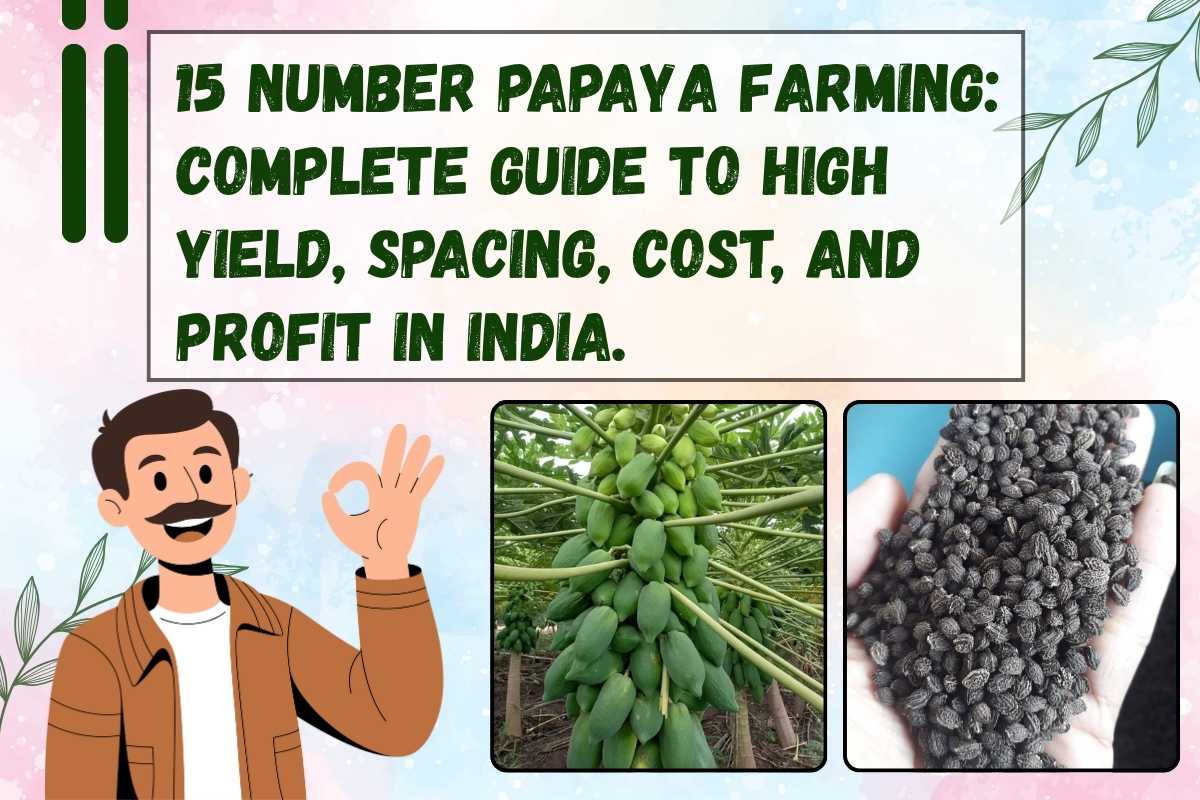
15 Number Papaya Farming (also known as Exp‑15/J‑15) is popular for uniform fruits, good disease tolerance, 1–1.2 kg fruit weight, and high yield potential under proper spacing and fertigation in Indian conditions.
What is 15 Number (Exp‑15/J‑15)?
- 15 Number is a hybrid line sold in India as Exp‑15 or J‑15 by multiple seed brands, positioned for high yield, orange‑red flesh, long‑oval fruits, and better tolerance to common diseases.
- Typical fruit weight is 1–1.2 kg with table‑purpose quality and medium shipping ability in 25–33°C tropical temperatures, suiting most Indian papaya belts.
Agro‑climate and Soil.
- Best temperature for 15 Number Papaya Farming is about 25–33°C with warm, frost‑free weather and good sunlight; avoid waterlogging and strong winds.
- Prefer well‑drained loamy soil near neutral pH; pit size of 60×60×60 cm with organic matter helps establishment.
Seed, Nursery, and Planting Time.
- Propagate by seed or tissue‑culture seedlings; seeds are economical while TC plants ensure uniformity and clean stock for 15 Number Papaya Farming.
- Common windows: monsoon‑end to early winter in many states to avoid heavy rains at transplanting; June–September is typical in South India while avoiding peak rains.
Click on the button below for plants or seeds.
Spacing and Plant Population.
- Standard papaya spacing is 1.8×1.8 m; high‑density options include 1.5×1.5 m to increase returns, and dwarf types can go to 1.25×1.25 m; select spacing per vigor of your Exp‑15 lot.
- At 1.25×1.25 m, about 2,590 plants/acre can be accommodated, a common high‑density benchmark for 15 Number Papaya Farming under drip.
Field Layout and Pit Preparation
- Mark square layout as per spacing, dig 60×60×60 cm pits, mix topsoil with 10–15 kg compost, 1 kg neem cake, and sand for drainage to support 15 Number Papaya Farming roots.
- Ensure raised beds or ridges in heavy soils to prevent collar rot due to waterlogging during rains.
Transplanting and Gap Filling
- Transplant sturdy 25–35 day seedlings with 4–6 true leaves; plant slightly deeper than nursery plug and firm soil for 15 Number Papaya Farming.
- In dioecious lots, plant 3–4 seedlings per pit and retain one best plant after sex identification, keeping ~10% males if required for pollination in female‑flowering types.
Irrigation and Mulching
- Use drip irrigation for uniform moisture; avoid over‑irrigation to prevent root diseases in 15 Number Papaya Farming.
- Black mulch suppresses weeds, saves water, and improves fruit cleanliness and early yield.
Fertilizer Schedule (General Guide)
- Annual nutrient ballpark per plant is often around 250 g N, 250 g P, and 500 g K split doses with micronutrients via fertigation for 15 Number Papaya Farming.
- Stage tips: use lighter NPK early, increase K from flowering to fruit fill; maintain Ca, Mg, B, Zn via foliar/drip to reduce disorders and improve TSS.
Training, Pruning, and Propping
- Maintain a single, straight stem with early staking in windy belts; remove lower leaves touching soil to reduce disease in 15 Number Papaya Farming.
- Where fruit load is heavy, provide soft ties or tripod props to prevent stem snapping in storms.
Weed and Orchard Floor Management
- Mulch + pre‑emergence weedicides as per label + shallow hand weeding to protect shallow roots in 15 Number Papaya Farming.
- Keep 0.5–0.75 m clear weed‑free ring around stems to reduce pest and disease refuge.
Pests and Diseases (Key Watchlist)
- Mealybug, PRSV (papaya ringspot virus), powdery mildew are major threats; adopt resistant/hybrid lines, rouging of viral plants, sticky traps, and need‑based sprays for 15 Number Papaya Farming.
- Field sanitation, vector control, and drainage are critical; remove infected plants early to break PRSV spread.
Papaya farming will earn you more than 10 times what Maize earns you a year
— Mynzagric254 (@mynzagric254) October 31, 2025
An acre population - 1000 PCs
1 seedling sh 150
Fruits a year per tree-100 PCs
An acre number of fruits -100,000
Sell each sh 50 on the lower side
Total sh 5000, 000
Deduct your expenses and… pic.twitter.com/4cRuMkR0dY
Flowering, Fruit Set, and Harvesting
- Flowering typically begins by 3–4 months after transplanting; first harvests often start around 7 months under good management in 15 Number Papaya Farming.
- Harvest at color‑break stage for markets farther away due to medium shipping ability; for local sales, deeper color improves taste and price.
Yield Benchmarks
- Under high‑density systems with drip and good agronomy, papaya orchards can yield roughly 60–65 t/ha, substantially higher than traditional 15–20 t/ha; per‑acre yield varies with spacing and care in 15 Number Papaya Farming.
- Some commercial nurseries quote up to 70,000 kg/acre for 15 No. plants under intensive care; treat such figures as upper‑range marketing benchmarks.
Economics Snapshot
- Market price usually fluctuates widely by season and region; typical public guides cite ranges like ₹10–₹20/kg for planning, but always survey local mandi and buyer contracts for 15 Number Papaya Farming.
- Gross and net returns depend on plant population, survival, grade, logistics, and IPM; high‑density with drip and consistent quality tends to maximize per‑acre revenue.
Variety Alternatives and Complements
- Alongside Exp‑15/J‑15, farmers commonly compare Red Lady 786 and Taiwan types for table use, with dwarf habits favoring closer spacing and early bearing.
- National and state packages of practices remain a reliable baseline for spacing and management choices across varieties, including 15 Number Papaya Farming.
Planting Density Options (Quick Guide)
- Conventional: 1.8×1.8 m for easy management and larger canopies in 15 Number Papaya Farming.
- High‑density: 1.5×1.5 m to enhance per‑acre returns if fertigation and IPM are strong.
- Ultra‑compact (for dwarf types): 1.25×1.25 m accommodating ~2,590 plants/acre as a reference ceiling where canopy allows.
Quality and Post‑Harvest
- Aim 1–1.2 kg uniform fruits with orange‑red flesh; careful harvest, de‑sapping, shade pre‑cooling, and clean crates help 15 Number Papaya Farming shelf life.
- Grade by size and color stage; medium shipping ability suggests fast turnover to nearby markets or controlled cold chain for distance.
Compliance and Sources of Truth
- Refer to NHB and ICAR/TNAU packages for baseline spacing, nursery, and planting windows aligned to state conditions for 15 Number Papaya Farming.
- Bayer FarmRise offers concise spacing and field practice reminders useful in field planning and thinning decisions.
Actionable Checklist
- Choose Exp‑15/J‑15 hybrid seed from reputable brands; verify lot vigor and germination for 15 Number Papaya Farming.
- Prepare pits and install drip with venturi for fertigation; schedule NPK splits and micronutrients by growth stage.
- Select spacing 1.5×1.5 m or 1.8×1.8 m per vigor and management level; consider 1.25×1.25 m only when canopy and labor support are assured.
- Implement IPM: traps, sanitation, vector control, and quick rouging for PRSV to protect productivity in 15 Number Papaya Farming.
Conclusion.
Exp‑15, 15 Number, and J‑15 are commonly used commercial labels; confirm exact hybrid specs on the chosen brand’s tech sheet before planting to align 15 Number Papaya Farming decisions.
FAQs
1) What is 15 Number papaya?
A- 15 Number (Exp‑15/J‑15) is a commercial hybrid known for uniform long‑oval fruits, orange‑red flesh, and typical fruit weight of 1–1.2 kg under tropical Indian conditions.
2) What climate and soil are best?
A- Warm, frost‑free regions around 25–33°C with full sun and well‑drained loamy soil; avoid waterlogging and strong winds to protect shallow roots.
3) When should I plant in India?
A- Common windows are June–September in many regions, with regional shifts to avoid heavy monsoon or frost risk for better establishment.
4) What spacing should I use?
A- Standard spacing is 1.8×1.8 m; high‑density options include 1.5×1.5 m, and ultra‑compact 1.25×1.25 m can accommodate about 2,590 plants/acre where canopy allows.
5) How many plants per acre at 1.25×1.25 m?
A- Approximately 2,590 plants per acre are accommodated at 1.25×1.25 m spacing in high‑density systems.
6) What irrigation method is recommended?
A- Drip irrigation ensures uniform moisture and supports fertigation; irrigate more frequently in summer and reduce interval during winter as per soil and climate.
7) What is a basic fertilizer plan?
A- Stage‑wise NPK via fertigation with emphasis on K from flowering to fruit fill, plus micronutrients; follow local package of practices for exact doses.
8) When does flowering and harvest start?
A- Papaya begins flowering around 3–4 months after transplanting; first harvests commonly begin around 6–8 months depending on management.
9) What is the expected yield?
A- Guides cite 60–65 t/ha potential under high‑density and good agronomy; per‑acre output varies with spacing, inputs, and survival rate.
10) Which pests and diseases are key?
A- Papaya ringspot virus, mealybugs, powdery mildew; prioritize sanitation, vector control, and rouging of infected plants for field longevity.
11) Is 15 Number better than Red Lady 786?
A- Both are popular; choose based on canopy vigor, spacing goals, and market preference, using national/state practice guides as a baseline.
12) What states grow papaya widely?
A- Major belts include Maharashtra, Tamil Nadu, Andhra Pradesh, Karnataka, Gujarat, and others with warm climates and market access.
13) How to reduce fruit drop and sunburn?
A- Maintain consistent moisture with drip, mulch to moderate soil temperature, and avoid nutrient stress; harvest at proper color stage for market distance.
14) What is the ideal seedling age for transplanting?
A- Healthy seedlings are typically ready within 45–60 days for field planting in prepared pits with FYM and neem cake.
15) How many seeds needed per hectare nursery?
A- Public packages mention around 500 g seed for one hectare nursery preparation in papaya systems.
16) Can ultra‑high density be used for all hybrids?
A- No, use ultra‑compact spacing only if the hybrid is dwarf/compact and management supports pruning, fertigation, and strict IPM.
17) What are common market uses?
A- Table fruit dominates, with additional demand for processing and papain enzyme in diversified value chains.
18) How to manage weeds effectively?
A- Use plastic mulch in high‑density systems plus shallow hand weeding early; drip + mulch reduces weed pressure significantly.
19) How to plan planting month by region?
A- Follow regional advisories: many areas plant June–September; North‑East may prefer February–March to escape frost at fruiting.
20) What fruit size does Exp‑15 target?
A- Exp‑15 commonly targets 1–1.2 kg fruits with orange‑red flesh and medium shipping ability suitable for short to mid‑distance markets.